← Home · Ground improvement

Vibrocompaction Design in Milton Keynes: BS 5930 Compliance

Together, we solve the challenges of tomorrow.

LEARN MORE →

Ground improvement in Milton Keynes demands precise design, and BS 5930:2015+A1:2020 is the starting point for every project we take on. The city sits on a mix of Oxford Clay, Lias Clay, and extensive made ground from decades of rapid expansion. Loose granular fill is common across the grid squares, and without proper densification, differential settlement becomes a near certainty. Our vibrocompaction design service targets these weak zones directly. We specify depth grids, probe spacing, and energy input based on Eurocode 7 limit state analysis. For sites near the Ouzel Valley, where alluvial deposits overlay the clay, combining our work with a CPT testing program verifies the improvement target before foundation loads are applied. This isn't a one-size-fits-all approach. It's a geotechnical response to local ground conditions.

A well-designed vibrocompaction grid turns loose fill into a competent bearing stratum in a single shift.

Our approach and scope

Milton Keynes has a split personality when it comes to ground conditions. The eastern expansion areas sit on thick glacial till and sand pockets that densify well under vibration. The western edges lean more toward the Lias Clay, which is cohesive and requires different treatment entirely. Vibrocompaction works where fines content stays below 15 percent. Above that threshold, we move to stone columns or rigid inclusions. Our design process starts with a granular assessment of the site's geomorphology. We plot the water table position, which in winter can rise to within a metre of the surface on the floodplain. The design then specifies the vibroflot type, usually an electric unit for urban sites to keep noise below the council's 65 dB limit at the boundary. We also define the compaction point layout. Triangular grids work best for uniform sands. Random patterns suit more erratic fills. Each design is verified with post-treatment penetration testing to confirm the relative density has reached the 70 percent minimum specified in BS EN 1997-1:2004 for shallow foundations.
Vibrocompaction Design in Milton Keynes: BS 5930 Compliance
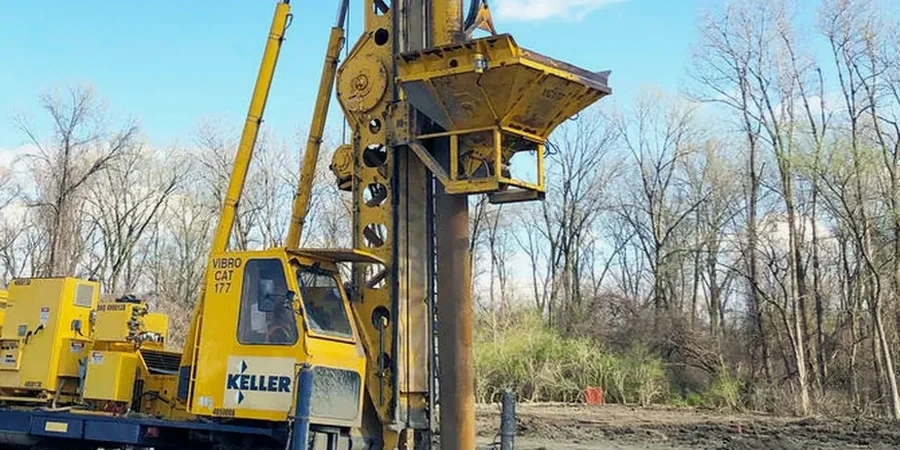
Technical reference image — Milton Keynes

Local considerations

The most common mistake on Milton Keynes sites is assuming that all granular fill is the same. It isn't. Much of the made ground in the older industrial estates contains brick fragments, ash, and occasional voids. Running a vibroflot across a void without prior investigation can collapse the working platform. We've seen contractors skip the pre-treatment CPT and then wonder why the rig sinks in a zone of old backfill. Another risk is ignoring the groundwater gradient. The city's balancing lakes and linear parks create a high water table in certain zones. Wet sands don't densify well. The pore pressure dissipates too slowly. Our design accounts for this by specifying staged passes or drainage prior to treatment. Getting the sequence wrong means the compaction energy is wasted. The post-treatment test then fails, and the project loses two weeks to re-treatment. That's a hard conversation with the client.

Need a geotechnical assessment?

Reply within 24h.

Email: contact@geotechnical-engineering1.com

Technical data

ParameterTypical value
Applicable StandardBS 5930:2015+A1:2020
Design CodeEurocode 7 (BS EN 1997-1:2004)
Max. Treatment Depth15 m below working platform
Target Relative Density≥ 70% (granular soils)
Grid TypeTriangular or square pattern
Fines Content Limit< 15% passing 63 μm sieve
Noise Constraint65 dB at site boundary (Milton Keynes Council)

Other technical services

01

Vibrocompaction Feasibility & Grid Design

Full design package including granular grading analysis, CPT correlation, grid layout with probe spacing and depth, power and water pressure specification, and post-treatment verification criteria. Suitable for Design and Build tenders.

02

Post-Treatment Verification Testing

Independent verification of achieved relative density using cone penetration testing (CPT) or standard penetration testing (SPT). We provide a signed compliance report confirming the ground meets the design specification.

Reference standards

BS 5930:2015+A1:2020 – Code of practice for ground investigations, BS EN 1997-1:2004 (Eurocode 7) – Geotechnical design. General rules, BS EN 1997-2:2007 – Ground investigation and testing, CIRIA C573 – A guide to ground treatment

Frequently asked questions

What is the typical cost of a vibrocompaction design for a Milton Keynes site?

A full vibrocompaction design package typically ranges from £1.090 to £4.260, depending on the site area, required treatment depth, and the number of design iterations. Smaller sites with simple ground conditions fall at the lower end. Larger industrial plots requiring detailed 3D modelling are at the upper end.

How do you verify that the vibrocompaction has worked?

We specify pre- and post-treatment penetration testing, usually CPT, at the centroid of the compaction grid. The design sets a target cone resistance value. If the post-treatment test meets that value across the treatment zone, the ground improvement is signed off. We can also use SPT if the site has gravel layers that obstruct the CPT cone.

Does vibrocompaction work in the Oxford Clay areas of Milton Keynes?

No. Vibrocompaction is only effective in granular soils with a fines content below 15 percent. The Oxford Clay and Lias Clay found across Milton Keynes are cohesive and require a different technique, such as stone columns or rigid inclusions. We assess the soil grading before recommending any treatment method.

What depth can vibrocompaction treat?

With standard electric vibroflots, we can treat loose granular deposits down to 15 metres below the working platform. The actual reach depends on the rig's power and the soil's resistance. We specify the target depth in the design based on the ground investigation data and the foundation loading requirements.
Location and service area

We serve projects in Milton Keynes and surrounding areas.

View larger map