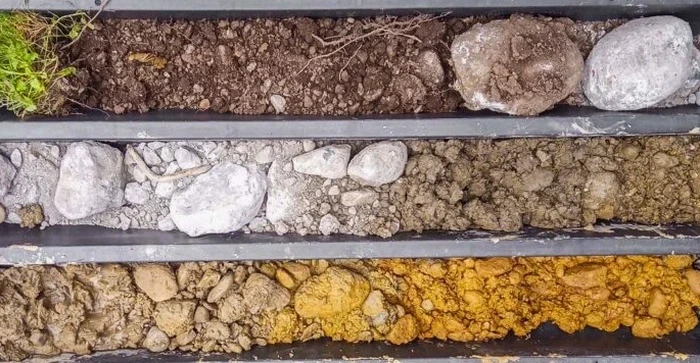
Milton Keynes sits at roughly 100 metres above sea level. It's a planned city built on Oxford Clay. That clay formation dictates everything for local construction. The geology here doesn't forgive guesswork. An exploratory test pit is the quickest way to see the soil profile with your own eyes. A 3-metre excavation reveals the topsoil, the weathered clay, and the water table. No indirect inference. Just hard facts you can photograph. For deeper mechanical data, we often follow up with an SPT drilling programme to get N-values through the same strata. The test pit anchors the desk study to reality.
Oxford Clay can lose 70% of its strength when it re-wets after a dry summer. A test pit shows you the current moisture state before you pour concrete.
Quick answers
How much does an exploratory test pit cost in Milton Keynes?
For a standard 3-metre pit with logging, sampling, and a factual report, the cost ranges from £410 to £690. The price depends on access constraints, the number of pits, and whether you need additional soakaway or CBR testing on the same day.
How many test pits do I need for a house extension?
We recommend two pits for a typical residential extension in Milton Keynes. One should be close to the existing dwelling to check the foundation depth. The second goes near the outer boundary to catch any lateral variation in the clay.
What is the difference between a test pit and a borehole?
A test pit is an open excavation, typically up to 4.5 metres deep. You can see the soil structure in situ. A borehole is a drilled hole that goes much deeper. The pit gives you a visual cross-section. The borehole gives you depth and samples from below the pit floor.
Do you backfill the pit and reinstate the surface?
Yes. We compact the arisings back in layers and reinstate the surface to match the original condition. If the pit is on a lawn, we replace the turf. If it's on hardstanding, we provide a temporary cold-lay patch.