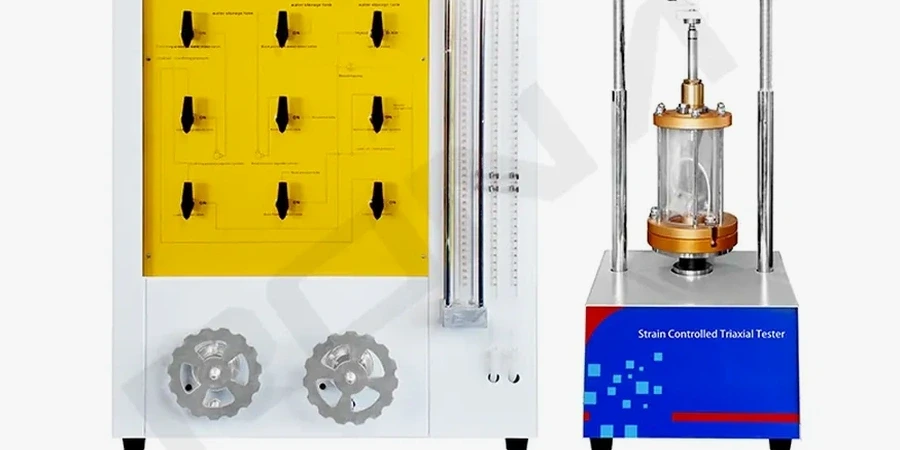
A triaxial cell pressurises a 100 mm specimen inside a Perspex chamber. Three GDS pressure controllers apply cell pressure, back pressure, and axial load simultaneously. We run the test in Milton Keynes on Oxford Clay and glacial till samples, often recovered from depths exceeding 25 metres. Pore pressure transducers log the response while LVDTs track vertical strain directly on the specimen. The system records deviator stress and excess pore pressure at one-second intervals. A local challenge is the weathering crust on the upper Oxford Clay — it degrades sample quality fast. We trim specimens within hours of sampling to preserve the natural structure. For the deeper Westbury Formation, we pair the multistage approach with CPT data to calibrate the in situ state before shearing.
A single well-executed multistage triaxial on Oxford Clay saves three boreholes and two weeks of lab time.
Quick answers
What does a triaxial test cost in Milton Keynes?
Cost depends on test type and confining stages. A single UU test starts near £1,380. A multistage CIU with three stages ranges from £1,550 to £1,930, including saturation, consolidation, and reporting. Specimen preparation from disturbed samples adds extra charges.
Which triaxial type suits Oxford Clay?
Consolidated undrained (CIU) with pore pressure measurement. Oxford Clay is a low-permeability, overconsolidated material. CU testing gives effective stress parameters c' and φ' needed for long-term design. Multistage CU is efficient when sample recovery is limited.
How long does a multistage triaxial test take?
Saturation alone takes 5–7 days on Oxford Clay. Consolidation at each stage adds 24–48 hours. Shearing at three confining pressures totals roughly one week. A complete multistage CIU report is typically delivered in 18–25 working days.
What sample quality is required?
We need Class 1 or Class 2 samples to BS EN 1997-2. U100 tubes or triple-tube core barrels work well. Disturbed bag samples are only suitable for remoulded testing. Specimens must be trimmed within 24 hours of extrusion to preserve natural water content.
Can you test glacial till from Milton Keynes sites?
Yes. Glacial till contains gravel clasts up to 60 mm. We use 100 mm diameter specimens to maintain a minimum 5:1 diameter-to-particle ratio. Where clasts are too large, we run remoulded and recompacted specimens to target density from nuclear density gauge records.