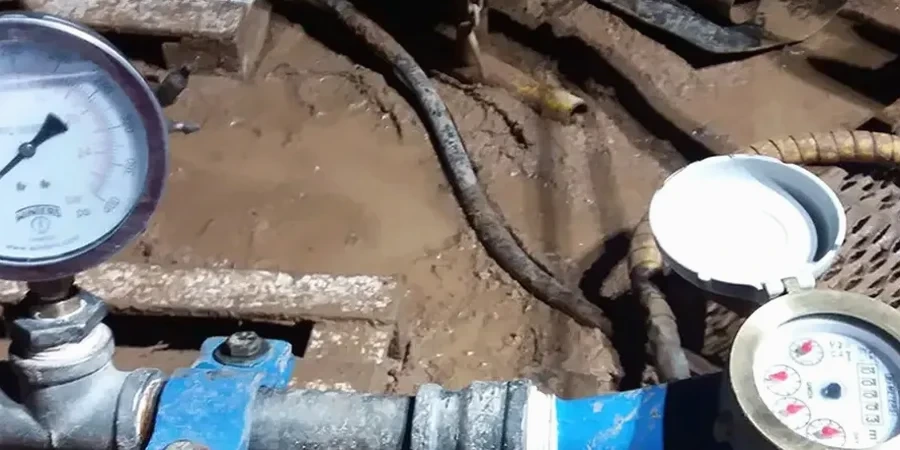
BS 5930:2015 makes it clear: a desk study alone won’t tell you how water actually moves through the ground, and in Milton Keynes that gap can stall a drainage design overnight. The city sits on a patchwork of glacial till over Jurassic Oxford Clay, where permeability can swing from 10-5 m/s in a sandy lens to practically impermeable at depth. For soakaway sizing under BRE Digest 365 and temporary works dewatering on the expanding eastern expansion areas, we run the Lefranc test in shallow boreholes and the Lugeon test when the investigation reaches bedrock. The output isn’t just a coefficient – it’s the difference between a basin that drains in 24 hours and one that backs up after the first winter storm. We’ve seen both scenarios play out on sites east of the M1, and the data always pays for itself.
In Milton Keynes, a soakaway designed without a field permeability test is essentially a pond waiting to happen – and not the kind the planners intended.
Our approach and scope
Milton Keynes was planned as a low-density, grid-road city from the 1967 designation onward, which means greenfield sites were turned into balancing ponds, linear parks, and SUDS features long before the term became industry standard. That legacy is relevant here: many of those early drainage basins were built without in-situ permeability data, relying instead on generic soil maps. Today, when we test a site near the Grand Union Canal or the Ouzel valley, we’re often retroactively calibrating the assumptions behind 40-year-old infrastructure. The Lefranc method gives us point-source hydraulic conductivity in the overburden – typically 2 to 10 metres depth – while the Lugeon test is reserved for the Cornbrash limestone and Great Oolite where fracture flow dominates. In weathered till near Wolverton, we’ve measured a 50-fold variation in k-value across less than 3 horizontal metres, which says everything about why single-borehole correlations don’t work here. A modern
CPT soil profiling run alongside permeability testing can map the stratigraphy fast, and for sites near the floodplain the
seismic refraction survey helps us spot buried channels that would distort any single-point measurement.
Quick answers
What does a field permeability test cost in Milton Keynes?
For a single Lefranc test at one depth in a soil borehole, the cost typically falls between £550 and £820, including the drilling setup, packer deployment, data logging, and the interpretive report. A Lugeon test in rock adds packer complexity and longer test durations, so it sits at the upper end of that range. The final figure moves with the number of test intervals, access conditions, and whether we’re combining the permeability testing with a wider ground investigation programme.
Do I need a Lefranc test or a Lugeon test for my MK site?
It depends entirely on what the borehole encounters. In most Milton Keynes locations, the overburden is 3 to 12 metres of glacial till or weathered Oxford Clay – that calls for a Lefranc test. If the borehole reaches competent limestone (Cornbrash or Great Oolite) and water is moving through fractures rather than pores, the Lugeon test becomes the right tool. We typically decide in real time based on the driller’s log and the presence of any water strikes.
How long does a field permeability test take on site?
A single Lefranc test interval usually takes 40 to 60 minutes once the borehole is prepared and the packer is set. A complete Lugeon test with the full five-pressure-stage cycle runs closer to 90 minutes per interval, because we need time for flow to stabilise at each pressure step. On a typical Milton Keynes investigation, we can complete two to three test intervals in a single day alongside other in-situ testing.
Can you use the permeability result directly for soakaway sizing?
Yes, and that is what most of our Milton Keynes clients need. The k-value from the Lefranc test feeds straight into the BRE Digest 365 calculation for soakaway dimensions and half-emptying times. We include the reduction calculation in our report so the drainage engineer can move straight to detail design without reinterpreting raw data. For deep soakaways that penetrate both till and limestone, we recommend testing at the proposed invert level rather than relying on a single average value.