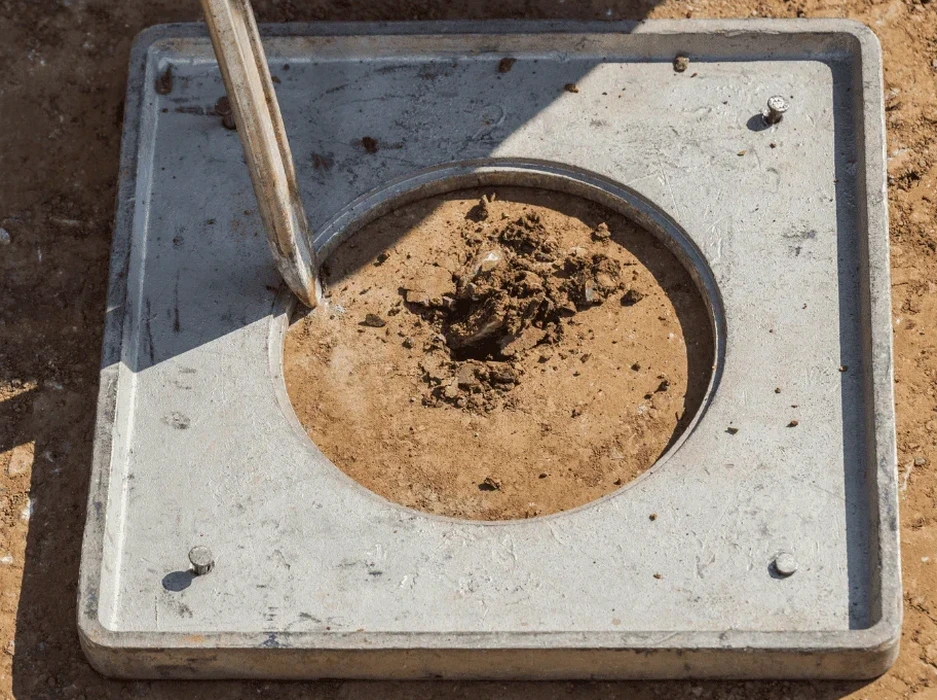
The first thing that arrives on a Milton Keynes job is the CPT rig — a 20-tonne truck with a hydraulic ram that pushes an instrumented cone into the ground at a steady 2 cm per second. We run the cone through the loose sands under the Loughton Brook floodplain, and the pore pressure transducer picks up exactly where the water is trapped. That real-time data feeds straight into our van’s workstation, and within hours we know whether the soil is going to hold its strength during a tremor. Most people forget that Milton Keynes sits over a patchwork of Oxford Clay and river terrace gravels — around 52.04° N, there is just enough granular material in the alluvial channels to cause trouble if it gets fully saturated. Before any foundation goes in near the Grand Union Canal or the Ouzel Valley, we combine the CPT trace with seismic microzonation logic to check for grain-supported fabrics that could destabilize under cyclic loading.
Liquefaction in the UK is not about magnitude 7 events — it is about thin saturated sand lenses that nobody mapped until the CPT pore pressure data came back positive.
Our approach and scope
Contrast the stiff boulder clay on the western edge of town with the silty lenses we find near Willen Lake. Over by Stony Stratford, the glacial till sits dense and over-consolidated — you would struggle to trigger excess pore pressure there even with a long-duration event. But move east towards Broughton and the profile changes: thin beds of fine sand interlayered with soft clay, perched water tables that nobody expected until we dropped a piezometer in. In our experience, it is that interface between the Oxford Clay cap and the underlying river gravels that causes the most head-scratching. You get a confined layer where drainage is practically zero, and a cyclic stress from even a moderate UK event can push the effective stress down to nothing. That is why we run resonant column tests on Shelby tube samples from those specific horizons, measuring shear modulus degradation at strains below 0.001% to model what really happens when the ground shakes.
Site-specific factors
What we keep seeing around the grid-road estates is developers relying on desk-study boreholes that stopped at 10 metres, missing the sand pockets entirely. A site off the H3 Monks Way looked clean on paper — firm clay all the way — but when we pushed the CPT deeper we hit a 1.8-metre band of clean medium sand at 11 metres, fully saturated, with a Bq of 0.8. That is a contractive soil just waiting for a trigger. The real risk in Milton Keynes is not the shaking magnitude, it is the zero-drainage condition in these interbedded sequences. If you are piling into the Kellaways Sand and ignoring the thin silt layers above, you are betting the factor of safety on luck. We have learned to never sign off a liquefaction assessment without at least one dissipation test per critical horizon, because the drainage path in these urban catchments is often blocked by adjacent basement construction and road embankments.
Quick answers
Is liquefaction a real risk in Milton Keynes given the low UK seismicity?
Yes, and we have the CPT traces to prove it. The UK experiences around 200–300 earthquakes annually, with occasional events around magnitude 5. In Milton Keynes, the combination of shallow water tables and loose alluvial sand lenses in the Ouzel and Loughton valleys creates the exact conditions needed: saturated, contractive granular soil at depths less than 15 metres. A peak ground acceleration of just 0.05g can trigger excess pore pressure if the sand is loose enough. We have measured SPT N1(60) values below 8 in several sites near the Grand Union Canal, which puts them firmly in the liquefiable category under BS EN 1998-5 screening criteria.
What is the typical cost of a soil liquefaction analysis in Milton Keynes?
A full liquefaction assessment with CPTu profiling, sampling, and cyclic laboratory testing usually falls between £1,760 and £3,180 depending on the number of test points and the depth of the critical layers. Sites with multiple sand lenses or deeper groundwater typically require more dissipation tests and additional resonant column specimens, which pushes the cost towards the upper end of that range.
How do you differentiate between clay sensitivity and sand liquefaction in the field?
The pore pressure transducer tells the story. In a sensitive clay, the excess pore pressure builds slowly and the dissipation curve is gradual. In a contractive sand, the Bq spikes almost instantly when the cone tip passes through a loose zone, often reaching values above 0.8. We also look at the soil behaviour type index (Ic) from the normalized CPT data — anything below 2.6 tends to be granular and drains fast unless the structure is very loose. When we see a low Ic combined with a high Bq, we know we are dealing with a true liquefiable soil, not just a sensitive fine-grained deposit.
What mitigation options do you recommend if liquefaction is confirmed?
It depends on the depth and thickness of the liquefiable layer. For shallow deposits down to about 5 metres, we often specify vibrocompaction or stone columns to densify the sand and provide drainage paths. For deeper layers, rigid inclusions or piled foundations that bypass the critical zone are the safer route. In some cases near existing structures where vibration is a concern, we have used permeation grouting to stabilize the sand without disturbing the neighbours. Every mitigation design comes with a verification programme — usually post-treatment CPTu runs to confirm the improvement in tip resistance and pore pressure response.