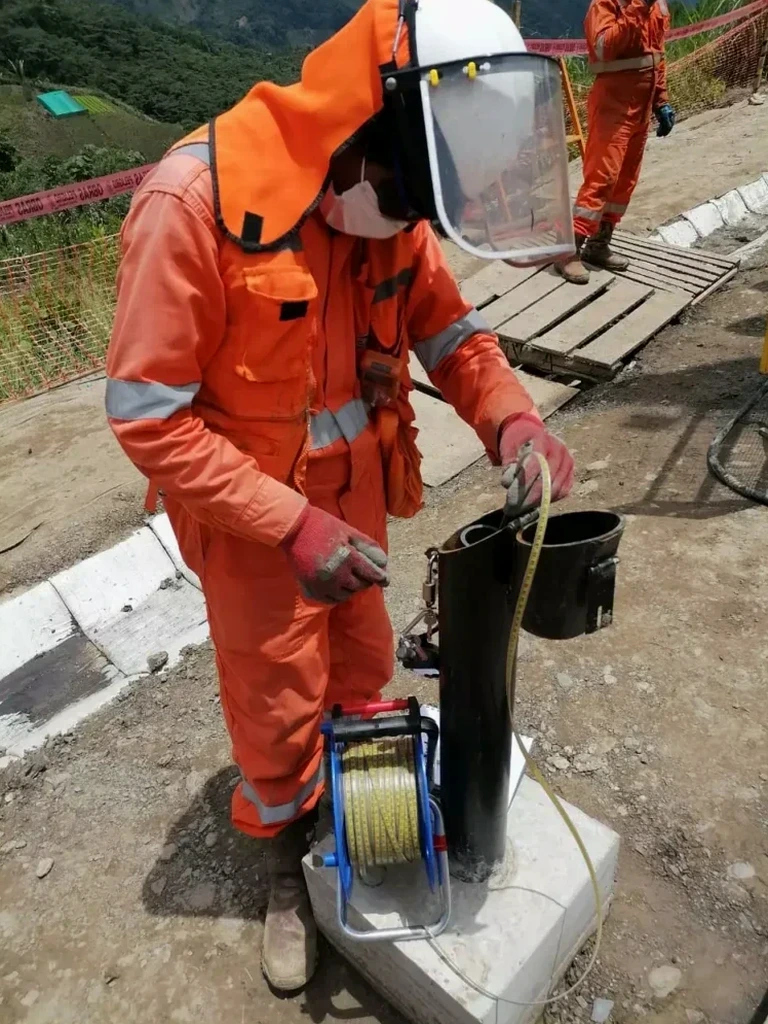
Milton Keynes sits on a geological boundary where Jurassic Oxford Clay meets Quaternary glacial till and alluvial sands—conditions that demand precise geotechnical data before any foundation design. The Cone Penetration Test (CPT) provides exactly that: a continuous, high-resolution profile of soil behaviour without the disturbance associated with traditional drilling. In a city that has expanded rapidly since its designation as a New Town in 1967, much of the infrastructure rests on variable ground, and the Environment Agency’s flood zone maps show significant alluvial corridors along the Great Ouse and its tributaries. We deploy tracked CPT rigs capable of penetrating the stiff clay bands that characterise the Woburn Sands Formation, delivering real-time data on tip resistance, sleeve friction, and pore pressure. For projects where the clay becomes particularly dense, we often recommend pairing the CPT investigation with rotary SPT drilling to verify refusal depths and obtain physical samples where needed.
A single CPT sounding in Milton Keynes can replace three boreholes when the goal is to map the vertical extent of soft alluvium beneath a proposed raft foundation.
Site-specific factors
The British Geological Survey maps for the Milton Keynes area show a complex patchwork of glacial till, glaciofluvial sand, and laminated clay, with groundwater often encountered within 2 metres of the surface in the Ouzel Valley corridor. A site investigation that skips CPT profiling risks misclassifying dense glacial till as competent Oxford Clay at depth, which can cause engineers to overestimate end-bearing capacity for piled foundations. The laminated clays are also prone to inclined shear surfaces, particularly on slopes greater than 8 degrees near the city's many balancing lakes. Without continuous cone resistance data, thin sand partings that act as drainage paths for groundwater—and accelerate consolidation settlement—are frequently missed. The most costly failures we see in the region involve floor slabs of light industrial units cracking within two years of construction because soft lenses less than 400 mm thick were undetected by standard trial pitting alone.
Quick answers
How much does a CPT test cost in Milton Keynes?
For a standard CPT sounding in Milton Keynes, budget between £130 and £200 per metre, depending on depth and whether piezocone (CPTU) with dissipation testing is required. Mobilisation cost is typically quoted separately and depends on the number of soundings.
How deep can a CPT rig penetrate in Oxford Clay?
In the stiff, overconsolidated Oxford Clay found across much of Milton Keynes, our 20-tonne tracked CPT rig typically reaches 25 to 30 metres. Refusal may occur earlier if dense limestone bands within the clay are encountered, in which case we recommend switching to SPT drilling to continue the investigation.
What is the difference between CPT and SPT for a site in Milton Keynes?
CPT provides a continuous, high-resolution profile of tip resistance and sleeve friction without disturbing the soil, whereas SPT yields a single blow count per 1.5-metre interval and retrieves a disturbed sample. On Milton Keynes sites with soft alluvial lenses, CPT is far better at detecting thin weak layers, but SPT is necessary when you need physical samples for classification tests like Atterberg limits.