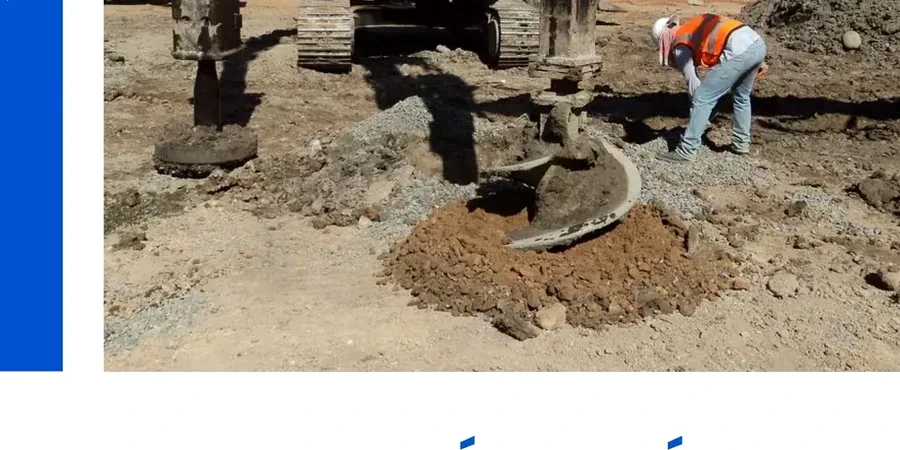
The geology of Milton Keynes presents a quiet but persistent challenge: beneath the surface of this planned city, extensive layers of soft Oxford Clay and alluvial deposits run across the Ouzel and Great Ouse valleys. These low-strength soils, often with high moisture content, demand careful foundation engineering. When conventional shallow footings fail to meet settlement criteria, stone column design offers a solid path toward ground improvement. Our team brings analytical rigour to each project, evaluating in-situ data from CPT test campaigns that map the transition between weathered clay and competent strata. The design process focuses on defining column spacing, diameter, and length to control total and differential settlement within the limits specified by BS EN 1997-1:2004, ensuring long-term performance under structural loads.
Designing stone columns in Oxford Clay demands precise settlement modelling, because under-estimating secondary consolidation can lead to unacceptable post-construction movement.
Our approach and scope
Milton Keynes sits roughly 60 miles northwest of London, with a population exceeding 280,000 and a development trajectory that continues to push into peripheral greenfield sites where ground conditions can be highly variable. A typical stone column installation here must account for the undrained shear strength profile of the Upper Lias Clay, often starting below 30 kPa in the near-surface. We define the area replacement ratio through iterative settlement analysis, integrating data from laboratory
triaxial testing to calibrate the friction angle of the compacted granular fill. Key design outputs include the unit cell stiffness, the load concentration factor on the column, and the resulting settlement reduction factor. The method works by creating a composite ground mass where the stone columns carry a disproportionate share of the applied load, while the surrounding clay provides lateral confinement. Verification protocols follow BS 5930:2015, requiring post-installation
plate load test programmes to confirm that the as-built stiffness matches the design intent.
Site-specific factors
The primary geotechnical risk in Milton Keynes is the presence of soft, normally consolidated clay with a high coefficient of secondary compression. In the Ouzel Valley corridor, alluvial silts and peats can appear at shallow depth, creating zones where even a well-designed stone column grid may experience excessive long-term settlement if the load transfer mechanism is not fully mobilised. A second concern is the potential for column bulging failure in the upper 2 to 3 diameters of the column, particularly where the clay crust is thin or desiccated. We mitigate this by specifying a higher replacement ratio near the surface and by confirming the clay's post-installation strength gain through follow-up CPT soundings. The design must also consider the proximity of existing infrastructure; in Milton Keynes' grid-road network, vibration from vibro installation requires monitoring to protect adjacent utilities and buried services.
Quick answers
What ground conditions in Milton Keynes are suitable for stone columns?
Stone columns are effective in soft cohesive soils with undrained shear strength between 15 and 50 kPa. In Milton Keynes, this typically corresponds to the Oxford Clay and alluvial deposits found in the river valleys. The technique is not suitable for peat with high organic content unless combined with a load transfer platform, nor for soils with a pH below 5.5 that could degrade the aggregate.
How much does a stone column design cost for a typical project?
For a standard residential or light commercial development in Milton Keynes, the design package including settlement analysis, column layout, and verification specifications typically ranges from £1,060 to £4,070. The final figure depends on the site area, the number of column positions, and the complexity of the ground model required.
How do you verify that the installed stone columns meet the design?
Verification relies primarily on plate load tests conducted on individual columns and on groups of columns, following the procedures outlined in BS 5930. We compare the measured load-settlement curves against the predicted behaviour from the design model. Additional CPT soundings between columns confirm the improvement in the surrounding clay due to installation-induced consolidation.
What is the difference between vibro compaction and stone columns?
Vibro compaction densifies granular soils through vibration and rearrangement of particles, and it works well in sands and gravels. Stone columns, by contrast, are a ground reinforcement technique for cohesive soils. They replace a portion of the soft clay with compacted granular columns that carry load and accelerate drainage. In Milton Keynes' clay-dominant geology, stone columns are the appropriate solution.