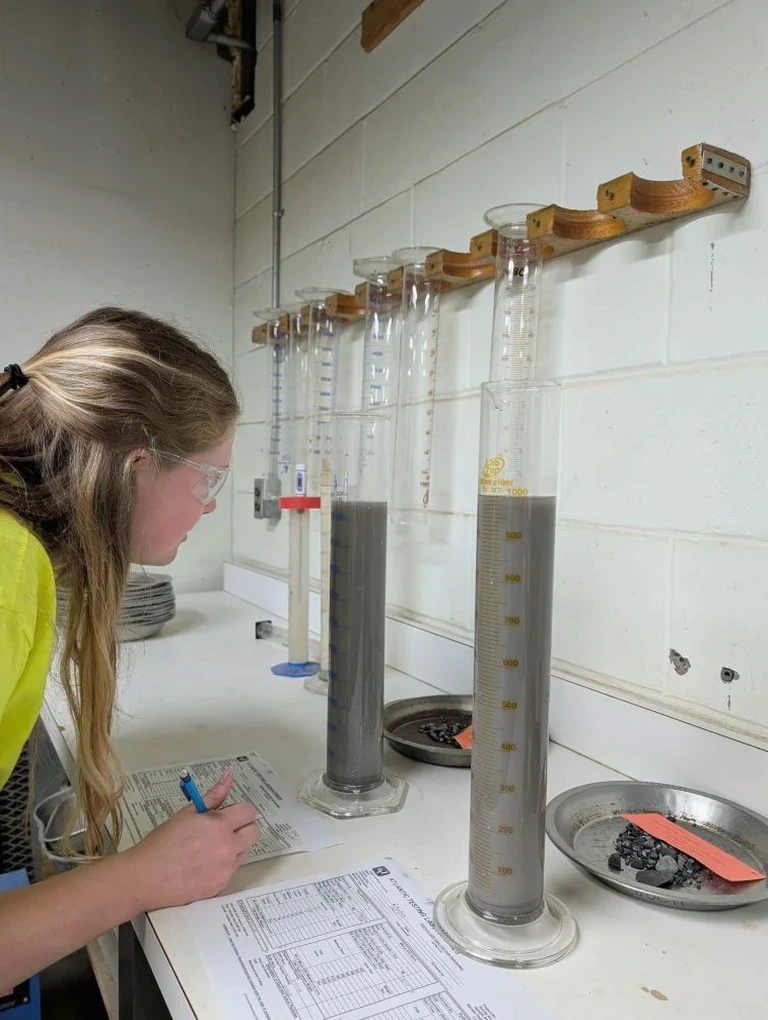
The biggest mistake we see with projects in Milton Keynes is contractors assuming the clay subgrade will hold up under traffic loads without a proper CBR value. The Oxford Clay here looks firm when dry but turns to slurry with a bit of water. You lay your pavement structure, and six months later the surface is cracking because the soaked CBR was half of what you designed for. We run the laboratory CBR test on remoulded samples compacted at optimum moisture content, then soaked for 96 hours to simulate worst-case conditions on site. It is the only way to get a CBR number that means something for pavement thickness design. For projects near the floodplain of the River Ouzel or around the grid roads, we often pair this with a plate load test to verify in-situ stiffness before the asphalt goes down.
A soaked CBR of 2% versus 5% can mean an extra 150 mm of sub-base — on a kilometre of road, that decision is worth tens of thousands of pounds.
Our approach and scope
Milton Keynes sits on a thick layer of Jurassic Oxford Clay overlain by glacial till in patches. The clay has high plasticity with liquid limits often above 50%, and its CBR can drop below 2% when saturated. That is a design risk you cannot ignore. Our laboratory CBR procedure follows BS 1377-4:1990, compacting the material in a CBR mould at three moisture contents to build the density-moisture relationship. Each specimen is soaked under a surcharge of 4.5 kg minimum before penetration with the standard plunger at 1.27 mm per minute. We read the force at 2.5 mm and 5.0 mm penetration and report the CBR as a percentage of the standard force. When the subgrade value comes back low, we discuss stabilisation options or look at the capping layer thickness specified in the Series 600 of the SHW. In some areas of the city, particularly around Bletchley, we have encountered made ground with brick rubble and ash, and the soaked CBR can vary wildly from one borehole to the next. That is where a quick in-situ density check with the sand cone helps confirm that what we tested in the lab matches what the roller achieved on site.
Site-specific factors
Milton Keynes has a split personality when it comes to weather. Dry summers crack the clay, letting water deep into the formation. Wet winters keep the water table high, often within a metre of the surface in the Ouzel Valley. That cycle means the subgrade rarely reaches equilibrium at the moisture content you assumed during design. A CBR test run at Proctor optimum without soaking will give you a dangerously optimistic number. We always run the full 96-hour soak because that is what the Specification for Highway Works demands for roads and what any sensible designer wants for car parks, industrial slabs, and access roads. Skipping the soak or running a single-point CBR on a bulk bag sample is a false economy. The lab condition simulates years of service in a few days, and the number you get is the one that keeps the pavement from rutting under HGV traffic.
Quick answers
What is the turnaround time for a soaked CBR test in your Milton Keynes lab?
The soaking period itself is 96 hours, and we need a day for compaction and a day for penetration and reporting. In practice, samples dropped off on Monday are reported by Friday afternoon. For time-sensitive projects we can run the CBR alongside grading and plasticity tests in parallel so you get the full suite in one week.
How much does a laboratory CBR test cost?
A single-point soaked CBR test typically costs between £110 and £170, depending on whether it is part of a larger suite of tests. The price covers compaction, soaking, penetration, and a full report with the CBR at 2.5 mm and 5.0 mm penetration plus the percentage swell.
Can you use the CBR test on stabilised soil or cement-bound material?
Yes. For cement-stabilised subgrade or capping we follow BS EN 13286-47, which adapts the CBR procedure for hydraulically bound mixtures. The curing period and soaking regime differ from the standard BS 1377 method, and we discuss the project specification with the engineer before starting to make sure we match the design assumptions.
How many CBR samples do I need for a typical housing development in Milton Keynes?
For a typical residential estate with 50–100 plots, we recommend at least one bulk sample per 200 m² of pavement area, taken from trial pits that cover the full footprint. If the ground conditions change — say from Oxford Clay to glacial till — you need separate CBR values for each material type. We can advise on a sampling plan once we see the site layout and the ground investigation data.