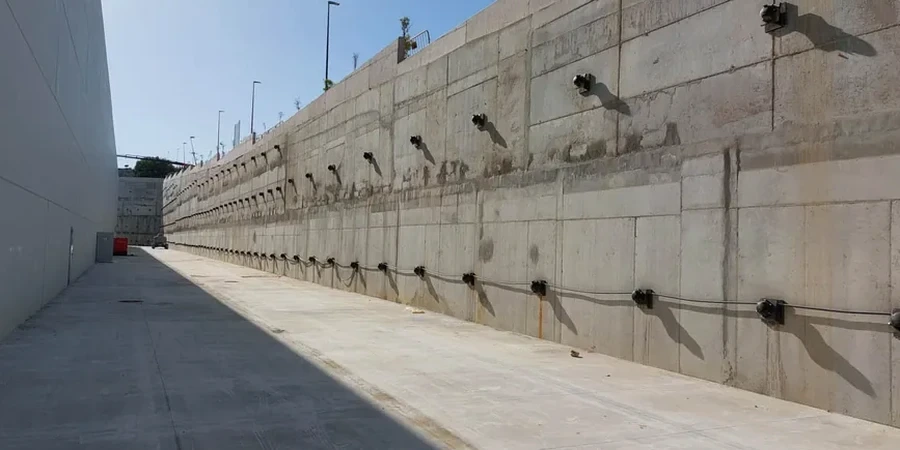
A common misstep we see in Milton Keynes is specifying a standard anchor length without accounting for the weathered zone at the top of the Oxford Clay. The site looks uniform during a walkover, but once you're three metres down the stiffness changes dramatically. That oversight leads to anchors that creep under load, and suddenly a perfectly good sheet pile wall starts tilting toward the excavation. Our team deals with this by designing each anchor bond length around the actual stratigraphy logged on site, not a textbook profile. We combine pull-out test data with the ground investigation logs to set the fixed length where it actually grips. For sites near the Grand Union Canal or around the grid roads where made ground is thicker than expected, we often recommend a preliminary campaign of CPT testing to map the soft pockets before locking in the tendon geometry.
Anchor capacity in Milton Keynes is rarely about the steel. It is about finding intact Oxford Clay below the weathered crust and fill.
Quick answers
What is the difference between active and passive anchors?
Active anchors are stressed after grouting to apply a pre-determined load to the retaining structure, which limits wall movement from the start. Passive anchors are not stressed; they develop resistance only when the wall starts to move and the ground deforms. In Milton Keynes we tend to specify active anchors for permanent works near sensitive structures, like retaining walls next to existing buildings in Central Milton Keynes, and passive anchors for temporary excavations where some displacement can be tolerated.
How much does anchor design and testing cost for a typical project?
For a retaining wall project in Milton Keynes with 20 to 40 anchors, the combined design, pull-out testing and proof load testing typically falls between £810 and £2,580 depending on the number of investigation tests required, the complexity of the corrosion protection and the monitoring duration. Each project is priced individually after we review the ground investigation data.
How deep do anchors need to go in Oxford Clay?
The bond length in intact Oxford Clay usually starts around 4 metres and can extend to 8 metres or more depending on the design load. The critical factor is getting below the weathered crust, which in Milton Keynes often extends 2 to 3 metres below ground level. We determine the exact fixed length based on site-specific pull-out tests, not generic tables.
What corrosion protection is required for permanent anchors?
BS 8081 requires Class I double corrosion protection for permanent anchors, which means two independent barriers between the steel tendon and the ground. Typically we use corrugated plastic sheathing filled with cement grout around the tendon, plus an outer grout column in the borehole. For temporary anchors with a service life under two years, Class II single protection may be acceptable, but we always check the aggressivity of the ground first.