← Home · Geophysics

Electrical Resistivity Testing (VES) in Milton Keynes

Together, we solve the challenges of tomorrow.

LEARN MORE →

The ground beneath Milton Keynes changes sharply within a single development plot. A site near the clay-heavy Ouse Valley can differ completely from one sitting over the Cornbrash limestone in the eastern grid squares. Electrical resistivity testing lets us see those transitions without breaking ground. A vertical electrical sounding (VES) array injects current and measures how the subsurface resists it. Clay returns low resistivity. Dry limestone or made ground reads much higher. In a city built on Oxford Clay with pockets of glacial till and alluvium, this contrast defines the depth to competent bearing strata. It also flags buried services, old backfill, and water pathways. We run the survey, process the data, and deliver a clear resistivity cross-section tied to your site coordinates. For sites where we need mechanical confirmation later, we often pair VES with test pits to calibrate the geophysical profile against a physical log.

Resistivity contrast between Oxford Clay and Cornbrash limestone can exceed 10:1 across a single Milton Keynes grid square.

Our approach and scope

Milton Keynes grew fast after the 1967 New Town designation, converting farmland and clay vales into a planned urban grid. That speed left a patchwork of fill, cut platforms, and retention ponds now buried under light-industrial estates. Electrical resistivity surveys cut through this legacy. We use a Schlumberger array for deep vertical profiling or a Wenner array when lateral continuity matters more. The technique works well across the Great Oolite Group limestones in the north and the mudstones that dominate the centre. A recent project near the M1 corridor identified a 4-metre band of saturated clay that would have been missed by trial pitting alone. For large-footprint warehouses, plate load testing confirms the modulus at formation level once the resistivity data has guided the borehole plan. In areas where vibration sensitivity rules out dynamic methods, we also combine resistivity with MASW surveys to jointly model stiffness and stratigraphy without any ground disturbance.
Electrical Resistivity Testing (VES) in Milton Keynes
Technical reference image — Milton Keynes

Local considerations

The Oxford Clay Formation under much of Milton Keynes can hold perched water within weathered zones just a few metres down. That condition creates a low-resistivity layer that masks deeper features if the array geometry is too short. Interpreting a VES dataset here means knowing the local drift geology: Head deposits, river terrace gravels, and glacially derived boulder clay all produce overlapping resistivity signatures. A false interpretation risks placing a foundation on softened clay or an undetected dissolution hollow within the limestone. The Environment Agency's groundwater protection zones add another layer. We cross-reference each sounding with British Geological Survey mapping and borehole records where available. When a layer boundary is ambiguous, we recommend a targeted SPT borehole to correlate resistivity with actual N-values and remove any guesswork from the ground model.

Need a geotechnical assessment?

Reply within 24h.

Email: contact@geotechnical-engineering1.com

Technical data

ParameterTypical value
MethodSchlumberger VES (vertical electrical sounding)
Maximum investigation depthTypically 30 to 60 m, depending on array spread
Typical measurement range0.5 ohm·m (wet clay) to >5000 ohm·m (dry limestone)
Electrode configuration4-electrode; Schlumberger or Wenner array
Data outputApparent resistivity curves, inverted true resistivity cross-sections, depth-to-layer tables
Survey standardBS 5930:2015 + A1:2020; BS EN 1997-1:2004 (Eurocode 7)
Typical survey line spacing5 to 25 m centres, site-dependent

Other technical services

01

Single-point VES sounding

One vertical electrical sounding at a target location. Ideal for pre-purchase due diligence or checking depth to rockhead beneath a proposed building footprint. We provide apparent resistivity curves, an inverted layer model, and a concise interpretive report within five working days.

02

Multi-point VES profiling

Multiple soundings along a survey line, producing a 2D resistivity cross-section. Used for road corridors, pipeline routes, and large commercial plots where lateral variation in clay thickness or fill depth must be mapped. Deliverables include fence diagrams and CAD overlays aligned to OS grid coordinates.

Reference standards

BS 5930:2015 + A1:2020 – Code of practice for ground investigations, BS EN 1997-1:2004 (Eurocode 7) – Geotechnical design, Part 1: General rules, BS EN 1997-2:2007 (Eurocode 7) – Ground investigation and testing

Frequently asked questions

What does a VES survey cost for a typical Milton Keynes plot?

A single-point VES sounding on a standard residential or light-commercial plot generally falls between £560 and £830. Multi-point profiling along a corridor runs higher because of the extra field time and data processing. The exact figure depends on access, array spread length, and how many soundings you need.

How deep can electrical resistivity testing go in Milton Keynes clay?

Depth depends on the current electrode separation. With a Schlumberger array and a maximum AB/2 spread of 100 metres, we can typically resolve layers down to 30–50 metres in Oxford Clay. Wet clay holds the current well, so penetration is usually good. Dry limestone or thick made ground can limit effective depth and needs a longer spread.

Can resistivity tell the difference between clay and limestone?

Yes, and the contrast is often strong. Saturated Oxford Clay typically reads below 15 ohm·m, while the Cornbrash and Blisworth limestones in the Milton Keynes area often exceed 100 ohm·m when dry. The boundary between them shows as a clear inflection on the apparent resistivity curve, which we invert to map depth and thickness of each layer.

Do you need site access for heavy equipment?

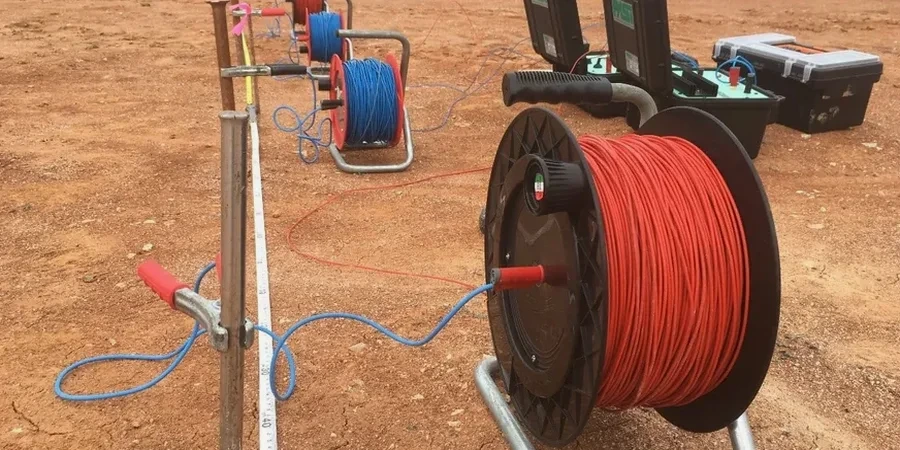
No heavy plant is required. A VES survey uses four electrodes pushed into the ground by hand, a resistivity meter, and cables laid across the surface. We can work on grass, compacted hardstanding, or pavement provided we can get a few millimetres of electrode contact. Access for a small van is usually sufficient.
Location and service area

We serve projects in Milton Keynes and surrounding areas.

View larger map