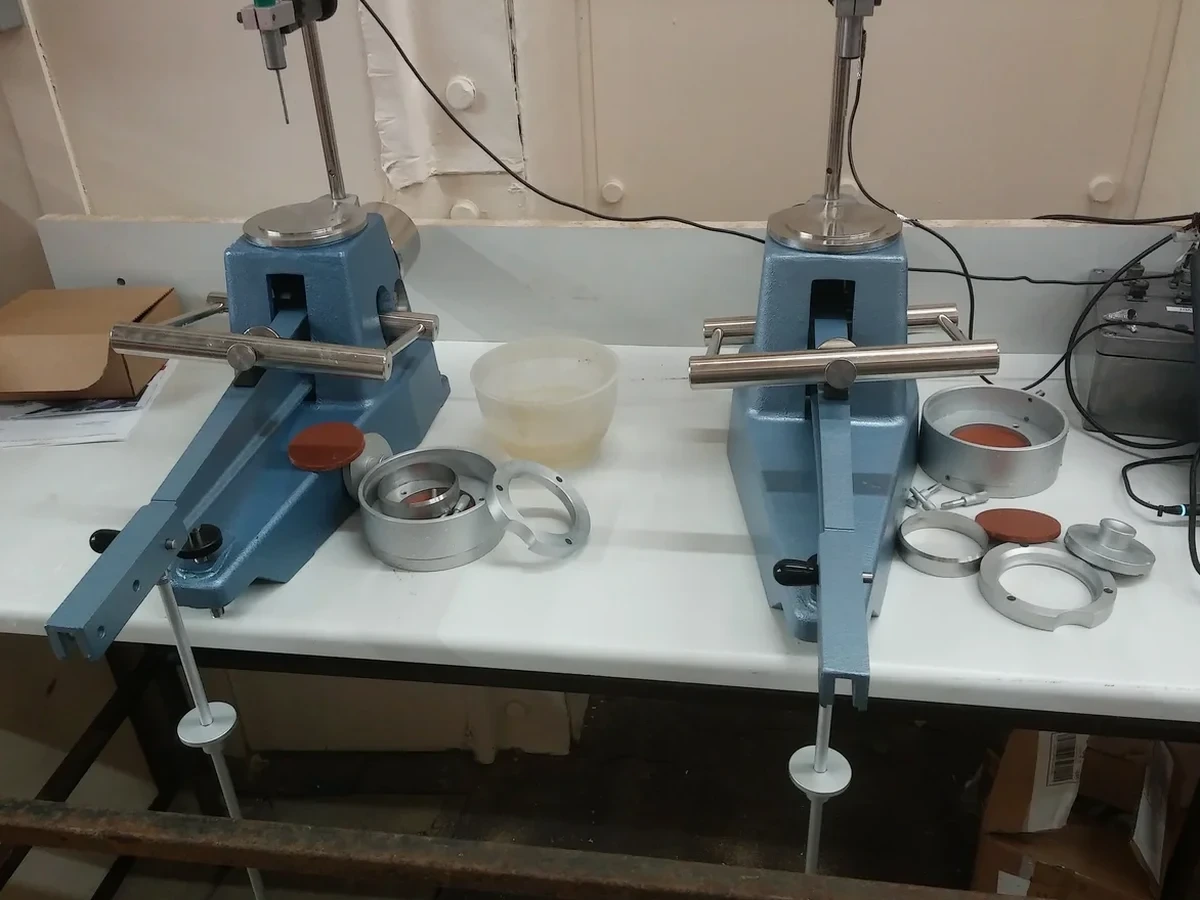
The clay in Broughton behaves differently from the silty drift material over in Kiln Farm. We see it in every set of samples. One contactor had a retaining wall design fail review because they assumed uniform plasticity across a Milton Keynes site. Three boreholes later, the Atterberg limits showed a 22% swing in liquid limit between the front and rear of the plot. That variance changes earth pressure coefficients directly. BS 5930 and Eurocode 7 Part 2 (BS EN 1997-2:2007) require classification testing on every stratum encountered, and our lab runs the fall-cone method to the current British Standard. The results feed directly into the Geotechnical Design Report. For deeper profiling of the underlying Oxford Clay, we often pair this with SPT drilling to correlate N-values with consistency index across the weathered and unweathered zones.
Two samples from the same borehole, three metres apart vertically, gave us a plasticity index of 18 and 41. That is the difference between a low-volume-change soil and a high-shrinkage one.
Our approach and scope
Milton Keynes sits at roughly 100 metres AOD on a plateau of Jurassic Oxford Clay overlain by glacial till and alluvium in the Ouse and Ouzel valleys. That geology means the Atterberg limits can shift sharply within a single residential plot. We run four-point liquid limit determination per BS 1377-2:1990, plus the plastic limit thread-rolling method. The lab reports the full set: liquid limit, plastic limit, plasticity index, and liquidity index against in-situ moisture content. Our technicians prepare samples from both disturbed bag samples and undisturbed U100 tubes. Turnaround is typically three to four working days. Rush service is available. Every result sheet includes the cone penetration curve, not just the single-point value some commercial labs try to get away with. That trace matters for audit and for peer review by the checking engineer.
Quick answers
How much do Atterberg limits cost per sample in Milton Keynes?
Standard liquid and plastic limit testing runs between £60 and £90 per sample, depending on whether you need the full four-point determination or a single-point check. Rush turnaround adds a surcharge. If you bundle it with particle size analysis, we can offer a combined rate.
What sample size do you need for the test?
We need a minimum of 200 grams of material passing a 425-micron sieve. That typically means about 500 grams of natural soil from a bag sample or a U100 tube. The sample must be sealed to prevent moisture loss between the site and the lab.
Why use the fall cone method instead of the Casagrande cup?
The fall cone is the preferred method in BS 1377-2 and is less operator-dependent than the Casagrande cup. It gives better repeatability and produces the full penetration curve, which lets the checking engineer verify the liquid limit value directly. Most UK ground investigation specifications now mandate fall cone only.
How do I interpret the plasticity index for foundation design?
The plasticity index, combined with the particle size distribution, places the soil on the Casagrande plasticity chart. A PI below 10 percent typically indicates silt, while above 20 percent indicates a clay with increasing volume-change potential. For Milton Keynes sites on Oxford Clay, we routinely see PI values above 30 percent, which triggers the need for a BRE SD1 shrinkage assessment under NHBC Standards Chapter 4.2.
Can you test samples from multiple boreholes on the same day?
Yes. Our lab processes batches from multiple boreholes or trial pits simultaneously. We track each sample by your unique reference so the results stay aligned with the exploratory hole log. If you are running a large investigation across several Milton Keynes grid squares, we can set up a dedicated work stream to keep turnaround tight.